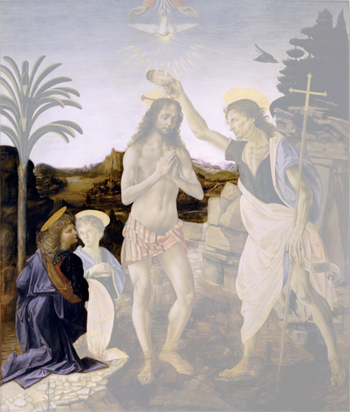
 Leonardo's drawing of the Baptism of Christ
The parts of the left image where the opacity has not been changed are thought to be the parts painted by Leonardo.
Leonardo was probably originally in charge of the background. In this painting, the landscape in the background clearly shows Leonardo's characteristics, and there is no doubt that it was painted by Leonardo himself.
It is thought that the next part given to Leonardo, who quickly finished the landscape, was the coloring of the angel's blue clothing. It feels as though the monochrome rough sketch for this part had already been completed by Verrocchio. This is because the depiction of the clothing has a realism and hardness that Leonardo did not have.
Finally, the depiction of the angel's hair on the left was the chance given to Leonardo, who had also safely completed the part about the angel's blue clothing.
The extent to which Leonardo could draw the angel's blue clothing was probably within the range of his master Verrocchio's expectations. However, Leonardo went beyond Verrocchio's expectations in depicting the angel's hair.
This was the moment when a genius representing the Renaissance was born.
|
The Baptism of ChristOil and tempera on poplar, 180 x 151.3 cm florence, galleria degli Uffizi
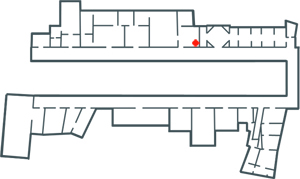
When I visited the museum before, this Baptism of Christ was displayed in the room next to the room where Botticelli's Birth of Venus was on display, but now there is a room dedicated to Leonardo in the opposite wing, so it seems to have been moved there. It feels quite strange that the exhibition room has been fixed for decades. This painting is painted with tempera on board. I had never seen tempera paintings like this before I went to Italy, so seeing a tempera painting for the first time was a fresh impression. In tempera paintings, the pigment itself is solidified on the surface of the painting, so the reflection of light is direct and strong, and the colors are vivid and strong. On the other hand, oil paintings are covered with oil, so the pigments are transparent and do not have the direct color intensity of tempera paintings. This painting painted with tempera also has the quick drying property of the paint, so you can directly feel the painter's touch, and you can feel that the painting is alive. The quick drying property of the paint prevents corrections such as repainting, so it is a true craftsmanship of one shot. The entire painting is filled with a sense of tension that does not allow for any mistakes, so the viewer is also enveloped in a considerable sense of tension. This demand for precise line drawing that cannot be redrawn is an area where Leonardo was weak. Leonardo lacked the line drawing technique of his contemporaries such as Botticelli, who could accurately trace the intended point. Even the curls of the angel painted in this Baptism of Christ by Leonardo do not come close to Botticelli's talent in terms of line drawing. The awkwardness of Leonardo's line drawing in this painting is exactly what you would expect from a painter who has not yet fully left his apprenticeship. However, there is also something special about it that other painters do not have. That is the sense of rhythm in the curls. The way the overall strength and balance are applied is exquisite. These are the unique talents and individuality of this artist that cannot be imitated, even if you try. As such, this painting is not simply a wonderful work of art, but is also a valuable piece of information that provides us with a wealth of information about Leonardo's position in his workshop at the time, how he acquired his painting skills, Verrocchio's skills, talent, and position in the workshop, and the circumstances of the other painters who were involved in the creation of this painting.
The Uffizi Gallery Museum
|

leonardoresearch.jp